
November 2026 - An 8% Investment-Grade Bond? What’s the Catch?
Historical context: this letter was published November 23, 2026. Its views, data and examples reflect that date and may not reflect current conditions.IN BRIEF • An unusual yield: A recent $32 billion SpaceX-related bond offering included investment-grade securities priced to yield more than 8%. • An important distinction: The entity responsible for making payments isn’t necessarily the entity issuing the bonds. That can affect investors’ rights if something goes wrong. • Complexity risk: Additional parties, contracts, and creditor rights can make recoveries harder to evaluate, even when a financing includes meaningful protections. |
How can a bond carrying an investment-grade credit rating offer a yield of more than 8% in today’s market?
That question caught our attention this week when a roughly $32 billion bond offering associated with SpaceX came to market. The largest portion of the offering was priced to yield approximately 8.26%, a notably high level for an investment-grade security.
So why were investors demanding so much compensation? Part of the answer may involve something we don’t often discuss in our client letters: complexity risk.
How the SpaceX Transaction Works
SpaceX is undertaking an enormous investment in computing infrastructure to support its artificial intelligence operations. Rather than simply borrowing money to purchase billions of dollars of advanced NVIDIA processors, the company has arranged an approximately $40 billion equipment-leasing transaction involving Apollo Global Management.
Under the arrangement, an Apollo-managed leasing entity will acquire the computing equipment and lease it to SpaceX. A related financing entity, Saturn Funding Trust, has issued bonds to help fund the transaction.
Investors purchase bonds issued by Saturn, while SpaceX is obligated to make lease payments that ultimately support repayment of those bonds.
Importantly, the lease contains strong contractual protections intended to keep SpaceX responsible for payments even if problems arise with the equipment. The financing also includes collateral and different classes of bonds with specified payment and recovery priorities.
These protections can be valuable. But understanding how they work, including what happens if something goes wrong, requires more analysis than evaluating a conventional corporate bond.
Think of It Like Leasing a House
Imagine you want to buy a house.
In a traditional arrangement, you borrow money from a bank and purchase the property. You make mortgage payments directly to the bank. If you stop paying, the bank has a legal claim against you and a lien on the house.
Now imagine a different arrangement.
Instead of purchasing the house yourself, you lease it from a landlord. The landlord owns the property and finances its purchase through a bank. You make rental payments to the landlord, who uses those payments to repay the bank.
In our SpaceX example, SpaceX is the tenant, using the equipment and paying rent. The Apollo-managed entity is the landlord, owning the equipment and collecting lease payments. And Saturn plays a role similar to the bank, raising money from bond investors to finance the purchase.
If the tenant stops paying rent, the bank still wants its money. But its direct lending relationship is with the landlord, not necessarily with the tenant.
The bank may have rights to the rental payments and the house itself. Those protections could be quite strong, but exercising them may involve additional contracts, parties, and legal proceedings.
That illustrates an important distinction:
The risk that someone won’t pay you is not the same as the risk that you won’t be able to recover your money if they don’t.
A Visual Guide to the Financing Structure
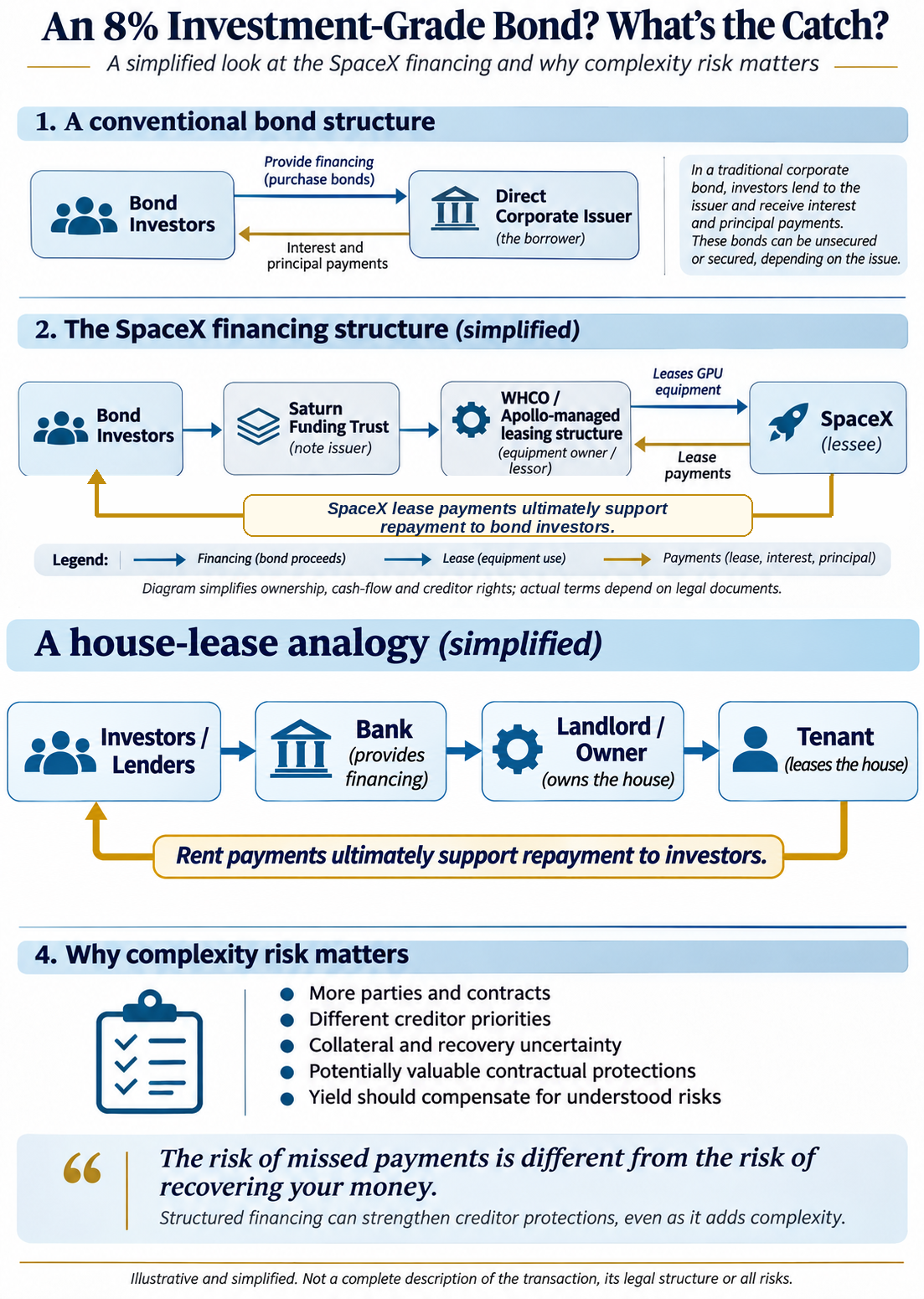 Illustrative diagram. In the house analogy, the bank represents Saturn’s financing role; Saturn is not itself a bank. Final legal rights depend on the governing transaction documents.
The Risk We Don’t Often Talk About
At Roosevelt Capital Management, we spend considerable time evaluating the creditworthiness of the issuers whose bonds we purchase. We want to understand their financial condition, their ability to service their obligations, and the protections available to us as creditors.
One risk we spend relatively little time discussing with clients, however, is complexity risk.
That’s not because complexity risk is unimportant. It’s because the types of fixed-income securities we generally purchase tend to have relatively straightforward structures, clearly defined payment obligations, and well-established creditor rights.
We favor investments where we can readily understand who owes us money, what our legal claims are, and what happens in the event of a default.
The SpaceX transaction illustrates a different type of financing. It involves multiple entities, equipment leases, collateral agreements, and different classes of securities with different rights to recoveries.
There is also the unusual nature of the collateral itself. Unlike a house, which may retain its usefulness for decades, advanced computer processors can depreciate rapidly as technology evolves. Their value in a distressed sale could be substantially less than their original purchase price.
And consider another possibility: What if the equipment securing the financing ended up in space? While SpaceX has indicated that these particular chips are intended for data centers on Earth, lenders reportedly sought restrictions preventing their deployment into orbit. After all, repossessing computer equipment is one thing. Repossessing computer equipment orbiting hundreds of miles above Earth is quite another.
None of this necessarily makes the bonds a poor investment. Carefully structured financing can sometimes provide creditors with greater protection than conventional unsecured debt.
But evaluating those protections requires understanding not just whether payments are likely to continue, but what investors can recover if they don’t.
Is the Extra Yield Worth It?
The approximately 8.26% yield on the largest portion of the offering certainly gets your attention.
Some of that yield reflects traditional credit considerations. Other factors may include the structure of the financing, uncertainty about collateral values, liquidity, and how the bonds might perform under stress.
An investment-grade credit rating is an important piece of information, but it doesn’t eliminate these risks or replace the need to understand the underlying investment.
At Roosevelt, we believe one of the advantages of fixed-income investing is the ability to construct portfolios around relatively predictable contractual cash flows.
That doesn’t mean every complicated investment should be avoided, or that simpler bonds are inherently safer. It means understanding the risks involved and determining whether the potential return adequately compensates investors for accepting them.
We don’t believe investors should take risks they don’t understand simply because the yield is attractive.
An attractive yield is easy to identify. Understanding everything that stands between that promised yield and actually receiving the money is the harder and more important part of fixed-income investing.
Sources and Notes
SpaceX announcement (October 26, 2026); KBRA preliminary rating announcement (November 16, 2026); Bloomberg pricing report (November 19, 2026); Financial Times reporting (November 20, 2026).
Disclaimer
Roosevelt Capital Management LLC is a registered investment adviser. This commentary is educational and is not individualized investment or tax advice. Investments involve risk, including loss of principal. Diversification, active management, rebalancing, and laddering do not guarantee returns or prevent losses. Past performance does not guarantee future results.